
Kendo

After years of a desk job, I found myself getting more
and more out of shape. I'm not a big fan of working out in a traditional gym
because I get bored with the repetition and lack of direction. I'd rather do
something with a bit more of a competitive spirit and something that also challenges
the mind. Organized sports have an appeal, but since I never know when I'm going
to have to work late, I always worry that I'd let down a team ...so I started
looking for some more individual sports to pursue.
I've always liked the martial arts and I had previously studied Kung-Fu and
Aikido, but I stopped after having back surgery. The though of going back to
a full contact fighting system wasn't really appealing to me as I don't heal
as quick as I used to. So I looked around at different martial arts systems
that would be less impact, but still give me a solid workout and keep my attention
focused on something while I was working out. I looked at getting into a good
Aikido school for a bit, but all the falling techniques were probably not the
best thing for my back. But while looking around for Aikido schools, I came
across a local Kendo school and figured I'd give it a shot. I'd heard of Kendo
before and in fact I thought about trying it in my early 20s, but never got
around to it. So I sat in a class and met some of the Sansei (teachers) at the
Long Beach school and they explained the basics to me. What I found the most
interesting was the deep mental aspects of Kendo, it is not just a sport or
system of techniques.
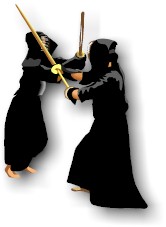
Kendo in it's basic terms is Japanese fencing or swordfighting. Although the
focus of Kendo is not the mechanics of how to fight with a sword ..but rather
how to achieve the proper mental state to swordfight without thought. The training
centers around doing EVERYTHING correctly ...and not just correctly, but PERFECTLY.
Kendo is essentially the physical practice of Zen Buddhism. From the steps of
correctly putting on your bogu (armor), through the proper use of your breathing
and voice, and to the execution of perfect technique without thought ..everything
in Kendo has a specific purpose for being exactly the way it is. For this reason,
Kendo has a really high turnover of westerners who come to learn the basics
of how to fight with a sword and find themselves doing nothing by trying to
strike a dummy with perfect form for six months without learning anything else
..all while being constantly corrected. Those who stay the course soon learn
that fundamentals are everything in Kendo ...it is not an art high in flash,
it is an art in perfecting the basics.
The following is taken from the website of the All
United States Kendo Federation
| About Kendo Kendo, is the art of Japanese fencing. "Ken" or tsurugi is from the character meaning sword. The character for "Do" or michi includes the meaning way or path which translates as "The way of the sword". A path in life which is followed through the training of kendo.
Origin of Kendo By the end of the 12th century, the authority of the Japanese central government had declined. Bands of warriors grouped together for protection forming local aristocracies. Feudalism had come of age, and was to dominate Japan for several centuries. With the establishment of the Shogun in Kamakura and military rule controlling Japan, a new military class and their lifestyle called Bushido, ìthe way of the warrior,î gained prominence. Bushido stressed the virtues of bravery, loyalty, honor, self discipline and stoical acceptance of death. Certainly, the influence of Bushido extended to modern Japanese society and Kendo was also to be greatly influenced by this thinking. The Japanese warrior had no contempt for learning or the arts. Although Kenjutsu, ìthe art of swordsmanship,î had been recorded since the 8th century, it gained new prominence and took on religious and cultural aspects as well. Sword making became a revered art. Zen and other sects of Buddhism developed and the samurai often devoted time to fine calligraphy or poetry. The next great advance in the martial arts occurred during the late Muromachi period (1336-1568) often call the ìage of Warring Provincesî because of the many internal conflicts. This period brought an increased demand and respect for men trained in the martial arts. Consequently, many schools of Kenjutsu arose, eventually numbering about 200. Each was taught by a famous swordsman whose techniques earned him honor in battle. Real blades or hardwood swords without protective equipment were used in training resulting in many injuries. These schools continued to flourish through the Tokugawa period (1600-1868), with the Ittoryu or ìone sword school,î having the greatest influence on modern Kendo. Kendo began to take its modern appearance during the late 18th century with the introduction of protective equipment: the men, kote and do and the use of the bamboo sword, the shinai. The use of the shinai and protective armor made possible the full delivery of blows without injury. This forced the establishment of new regulations and practice formats which set the foundation of modern Kendo. With the Meiji Restoration (1868) and Japanís entry into the modern world, Kendo suffered a great decline. The Samurai class was abolished and the wearing of swords in public outlawed. This decline was only temporary, however, interest in Kendo was revived first in 1887 when uprisings against the government showed the need for the training of police officers. Later the Sino-Japanese War (1894-95) and the Russo-Japanese War (1904-05) again encouraged an awareness of the martial spirit. Consequently in 1895, the Butokukai, an organization devoted to the martial arts was established. In 1911, Kendo was officially introduced into the physical education curriculum of middle schools and in 1912, the Nihon Kendo Kata, a set of regulations for Kendo, was published. In 1939 as Japan prepared for war, Kendo became a required course for all boys. After the war, because of its nationalistic and militaristic associations, Kendo was outlawed and the Butokukai was disbanded. However by 1952, supporters of Kendo successfully reintroduced a ìpure sportî form of Kendo, called Shinai Kyogi which excluded the militaristic attitudes and some of the rougher aspects of practice characteristic of prewar Kendo, into the public schools. Today, Kendo continues to grow under the auspices of the All Japan Kendo Federation, the International Kendo Federation, and federations all over the world. Although the outward appearance and some of the ideals have changed with the changing needs of the people, Kendo continues to build character, self-discipline and respect. Despite a sportlike atmosphere, Kendo remains steeped in tradition which must never be forgotten. For here lies the strength of Kendo which has carried it throughout history and will carry it far into the future. |