
 I Ching
Interpreted by wu wei

The Yarrow Stalk Method
Fifty yarrow stalks are used. One is symbolically laid aside and plays the role of observer until your inquiry is completed. Because there is a spiritual value in laying aside the observer stalk, I always pick it up at the end of my inquiry and thank it for its participation, and I thank the venerable ancient sages for their presence and assistance.

The most important spiritual quality one can develop is
that of reverence for all things. All That Is is aware of you, and your reverence
shows that you are aware of All That Is.
Carefully follow the eleven steps of dividing the yarrow stalks.
1. Hold the bundle of 49 stalks in your left hand. Think
about your question and the circumstances which gave rise to the question. If
the question has to do with a person, visualize that person. If a problem is
the subject of your inquiry, think about the various aspects of the problem.
See in your mind’s eye the people or objects associated with the question.
Close your eyes; hold the question in your mind.
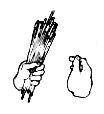
2. With your right hand, grasp a portion of stalks from
the bundle held in your left hand.
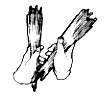
3. Place the bundle you have grasped in your right hand
on the blanket and take from it one stalk.
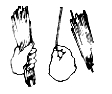
4. Place that stalk between the little finger and ring
finger of your left hand.
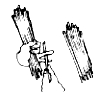
5. With your right hand, take bundles of four from the
stalks remaining in your left hand until four or fewer stalks remain.
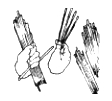
6. Place those four or fewer stalks between the ring finger
and middle finger of your left hand.
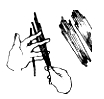
7. Take the remaining stalks that were in your left hand
and lay them down separately, retaining the stalks between your fingers.
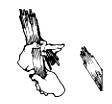
8. Pick up the bundle of stalks that you first removed
from your left hand and return that bundle to your left hand.
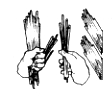
9. With your right hand, remove bundles of four until
there are four or fewer stalks remaining.
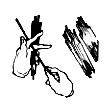
10. Place those four or fewer stalks between your middle
finger and your index finger and place the remaining stalks on the blanket,
retaining the stalks placed between your fingers.
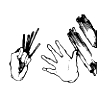
11. Count the stalks held between your fingers.
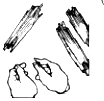
You must have either 9 or 5 stalks. If you have any number of stalks other than 9 or 5, you have either taken bundles of fours incorrectly, or you did not begin with the correct number of stalks. The various possibilities of stalks held between your fingers are:
Repeat steps 1 through 11.
When you have gone through the eleven steps the second
time, you must have either 8 or 4 stalks remaining between your fingers. Any
other number of stalks means you have manipulated the stalks incorrectly.
If you find that you have manipulated the stalks incorrectly, but you still
hold the stalks between your fingers, restore the stalks to their respective
bundles and count again. If you no longer hold the stalks between your fingers,
you must repeat that division of the stalks, but just for that one operation;
the first counting which resulted in 9 or 5 is still valid.
In the second grasping, the possible combinations of stalks held between your
fingers are:
9 (2) + 4 (3) + 4 (3) = 8
5 (3) + 4 (3) + 8 (2) = 8
5 (3) + 8 (2) + 4 (3) = 8
5 (3) + 4 (3) = 4 (3) = 9
You now are able to record the first line of your kua, which is the bottom line. The following numbers yield the following lines.